

What happens when the technology transforming engineering also starts transforming the way engineers learn?
Engineering education has traditionally focused on technical concepts, design software and established workflows. But today’s industry is changing rapidly. Artificial intelligence, automation, simulation and data-driven technologies are becoming part of modern engineering practices, creating demand for professionals who can work alongside these technologies.
The growing role of the AI engineer is one example of this shift. As organisations adopt AI across different functions, engineering professionals increasingly need to understand how intelligent technologies can complement their existing expertise. This is creating an important opportunity for education providers and entrepreneurs. Training that combines engineering fundamentals with emerging technologies can prepare learners for a changing workplace while creating a future-ready Business opportunity for education entrepreneurs.
According to the World Economic Forum’s Future of Jobs Report 2025, AI and big data are among the fastest-growing areas of demand, while 86% of employers expect AI and information-processing technologies to transform their businesses by 2030.
What Does AI-Powered Engineering Training Actually Mean?
AI-powered engineering training is not simply about adding an AI module to a conventional engineering course. It is about introducing AI into the way learners understand concepts, solve problems and complete projects. Learners can explore artificial intelligence models, pre-trained AI models and machine learning to understand how intelligent technologies can support engineering applications.
For example, during a product design project, AI-enabled tools can help learners explore design alternatives, identify patterns, automate repetitive processes or improve an existing design. Machine learning can also be introduced in areas such as optimisation, predictive analysis, simulation and quality monitoring.
The objective is not to make every engineering learner an AI researcher. Instead, it is to help them understand how AI can be applied to their engineering domain. This creates a learning environment where engineering knowledge and AI technology work together.
From Traditional Training to AI-Enhanced Learning: What Has Changed?

The move towards AI-enhanced learning does not mean replacing traditional engineering education. Instead, it adds new capabilities to an established foundation. Artificial intelligence in education can support more interactive learning experiences, quicker feedback and greater flexibility. AI can also contribute to personalised learning, allowing learners to explore concepts and resources according to their individual learning needs.
The role of trainers remains important. AI can support the learning process, but trainers provide context, explain engineering principles, evaluate projects and help learners make informed decisions.
Traditional engineering training
Traditional engineering training generally follows a structured Linear Process. A learner may first understand a concept, learn a software application, complete exercises and then apply that knowledge to a project.
For example, a traditional product development method may follow:
Concept → Design → Modelling → Testing → Modification → Final Product
This approach remains valuable because engineering fundamentals provide the foundation for professional practice. However, modern technology allows learners to explore this process in a more flexible and interactive way.
AI-powered engineering training
AI-powered engineering training introduces intelligent technologies into different stages of the learning process. With machine learning models, AI-assisted design tools and automation, learners can explore several possibilities, compare outcomes and improve their projects.
A modern workflow could look like:
Concept → AI-assisted exploration → Design → Simulation → Analysis → Optimisation → Prototype → Improvement
This changes the learner’s role. Instead of simply following a predefined process, learners can experiment, analyse results and make decisions. This is where AI Integration becomes valuable. AI becomes an additional tool for engineering problem-solving rather than a replacement for engineering knowledge.
The Future of Engineering Education Is Moving Beyond Conventional Training

Engineering education is becoming increasingly practical, technology-driven and connected to real industry requirements. One major development is Project-Based Learning. Instead of learning a technology only through isolated exercises, learners can apply it to projects that reflect real engineering challenges.
For example, a building design learner could develop a complete project while exploring different design options using digital and AI-assisted tools. Similarly, a product design learner could use AI during different stages of the development process. This approach helps learners understand not only how a technology works, but also where and when it can be applied.
The wider employment market is moving in the same direction. The World Economic Forum expects AI and big data to remain among the fastest-growing areas of demand through 2030. For education providers, this means training programmes need to evolve alongside the technologies being adopted by industry.
The Emerging Franchise Opportunity in AI-Powered Engineering Training
The growth of AI in engineering is creating demand from several learner groups. Engineering students want industry-relevant exposure. Graduates want to prepare for technology-driven workplaces. Working professionals need to update their knowledge as tools and workflows evolve. Organisations also need training that helps their teams adapt to technological changes. This creates a high-growth opportunity for education businesses that can serve different audiences.
An AI-powered engineering training centre can potentially cater to:
- Engineering students
- Fresh graduates
- Working professionals
- Design and engineering professionals
- Corporate learners
This makes the opportunity broader than a conventional training centre.
The World Economic Forum reports that 77% of employers plan to upskill or reskill their existing workforce in response to AI-related changes. This indicates that technology-focused learning is becoming relevant across different stages of a professional career. For entrepreneurs, an education model that serves students, professionals and organisations can create multiple opportunities rather than depending on a single learner segment. This is where an education business opportunity around AI-powered engineering training becomes particularly interesting.
Why CADD Centre Is Well Positioned for the AI-Powered Engineering Education Market?
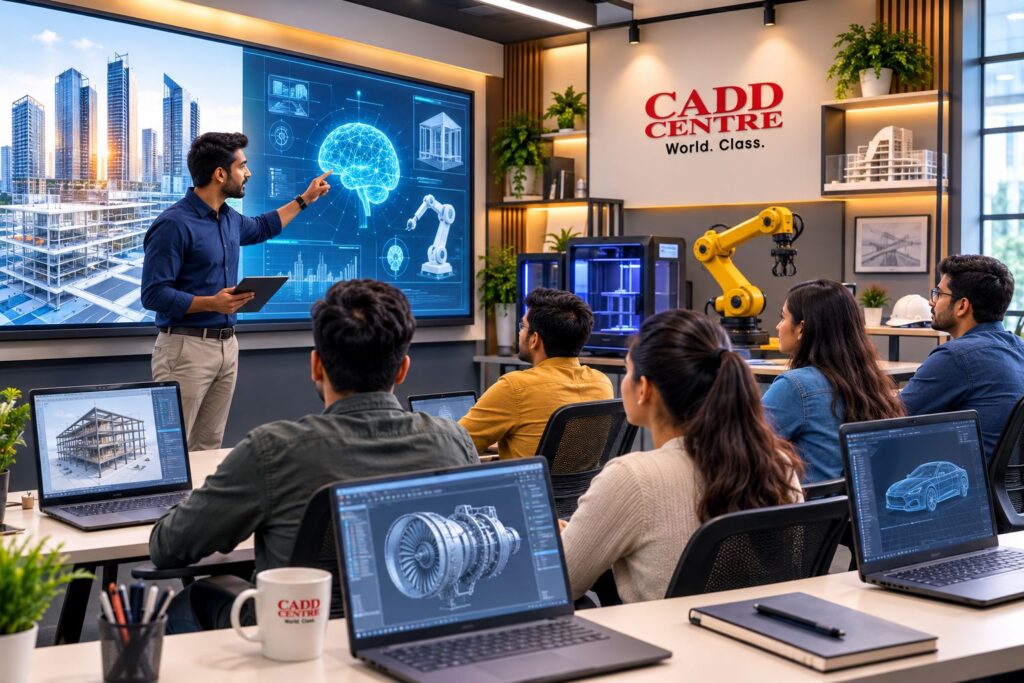
The shift towards AI-powered engineering education creates an opportunity for training providers that can combine established engineering knowledge with emerging technologies. This requires more than introducing an AI course. Learners need a learning environment where they can understand engineering concepts, use digital tools and explore how AI can improve real-world workflows.
CADD Centre is well placed to support this transition because its training focus is closely connected to engineering, design and digital technologies. Areas such as CAD, BIM, architecture and product design already form part of the modern engineering workflow, creating a natural space for introducing AI-enabled approaches.
This can help bridge the Gap between what learners traditionally study and the technologies they are increasingly likely to encounter in the workplace. Rather than treating AI as a separate subject, it can be introduced alongside existing engineering applications, allowing learners to understand its practical relevance. For franchise partners, this creates an opportunity to operate in an education segment that is evolving with industry. A CADD Centre franchise can serve different learner groups, from engineering students and graduates to working professionals looking to update their technical knowledge. This provides scope to offer programmes that respond to changing market requirements rather than relying on a fixed set of courses.
The franchise model also gives entrepreneurs an opportunity to build on an established training framework instead of developing every aspect of an education business independently. Support across areas such as training, marketing, centre operations and setup can help franchise partners focus on reaching learners and developing their local market.
Most importantly, the opportunity extends beyond today’s AI tools. As engineering workflows continue to evolve, training centres that can adapt their programmes to new technologies will remain relevant. For an entrepreneur, partnering with CADD Centre can therefore provide an opportunity to participate in the next phase of engineering education while building a technology-focused education business opportunity.
Conclusion
The future of engineering education is already beginning to look different. AI is changing engineering workflows, workplace expectations and learning requirements. As organisations continue to adopt intelligent technologies, the need for relevant and practical training is likely to grow.
For entrepreneurs, this creates a strong education franchise opportunity at the intersection of engineering, technology and lifelong learning. AI-powered engineering training can bring together engineering fundamentals, artificial intelligence models, machine learning, AI-assisted tools and Project-Based Learning. With an established education partner such as CADD Centre, entrepreneurs can build on an existing training ecosystem while entering a market shaped by emerging technology.
The next generation of engineers will not learn exactly as the previous generation did. The opportunity is to build the education centres that prepare them for what comes next. For entrepreneurs looking for a technology-led education business opportunity, partnering with CADD Centre can be a step towards building a future-ready training business.
FAQs
1. What is AI-powered engineering training?
AI-powered engineering training combines conventional engineering education with artificial intelligence, machine learning and AI-enabled tools. It helps learners understand how emerging technologies can be applied to areas such as design, simulation, product development and other engineering workflows.
2. How is AI changing engineering education?
AI is making engineering education more practical and interactive by supporting personalised learning, faster feedback, design exploration and automation. It also helps learners understand how AI can be integrated into real engineering projects and workflows.
3. Is AI replacing traditional engineering training?
No. AI is not a replacement for engineering fundamentals. AI-powered training builds on conventional engineering knowledge and introduces modern technologies that can help learners apply that knowledge more effectively.
4. Why is AI-powered engineering training a business opportunity?
The increasing adoption of AI across industries is creating demand for technology-focused education. A training centre can serve engineering students, graduates, professionals and organisations, creating multiple potential learner segments for an education business.
5. Why choose a CADD Centre franchise for AI-powered engineering training?
CADD Centre’s focus on engineering and design education provides a relevant foundation for introducing AI-enabled learning. A franchise partner can build on an established training framework while developing a local education business around changing industry requirements.